In-depth Interpretation of 24 Smart Construction Pilot City Implementation Plans, which Construction Robots are the Most Popular?
Oct 16
With the development of emerging technologies, the construction industry is transforming towards digitalization and intelligence. Intelligent construction has become a general trend. On November 9, 2022, the Ministry of Housing and Urban-Rural Development listed 24 cities as smart construction pilot cities to explore new paths for the transformation and development of the construction industry.
After the release of the notice, a number of pilot cities have released the implementation plan on promoting the synergistic development of intelligent construction, in which the application of construction robots is the focus.
So why are construction robots so important? What kind of robots are there in the construction industry? And how to apply it? Today, we take the 24 cities‘ implementation plans as a sample to explore these questions.
Facing Labor Difficulties, Construction Robots are the Trend
First, the use of construction robots is driven by reality.
According to the 2022 Farmworker Monitoring Survey Report released on April 28 this year, the number of farmworkers engaged in the construction industry decreased by 3.25 million in 2022, the largest decrease in the past five years, down 1.3% year-on-year. Meanwhile, the construction labor force is aging. According to the 2021 China Population and Employment Statistics Yearbook, the proportion of middle-aged and older people (aged 45 and above) among construction workers has been increasing.
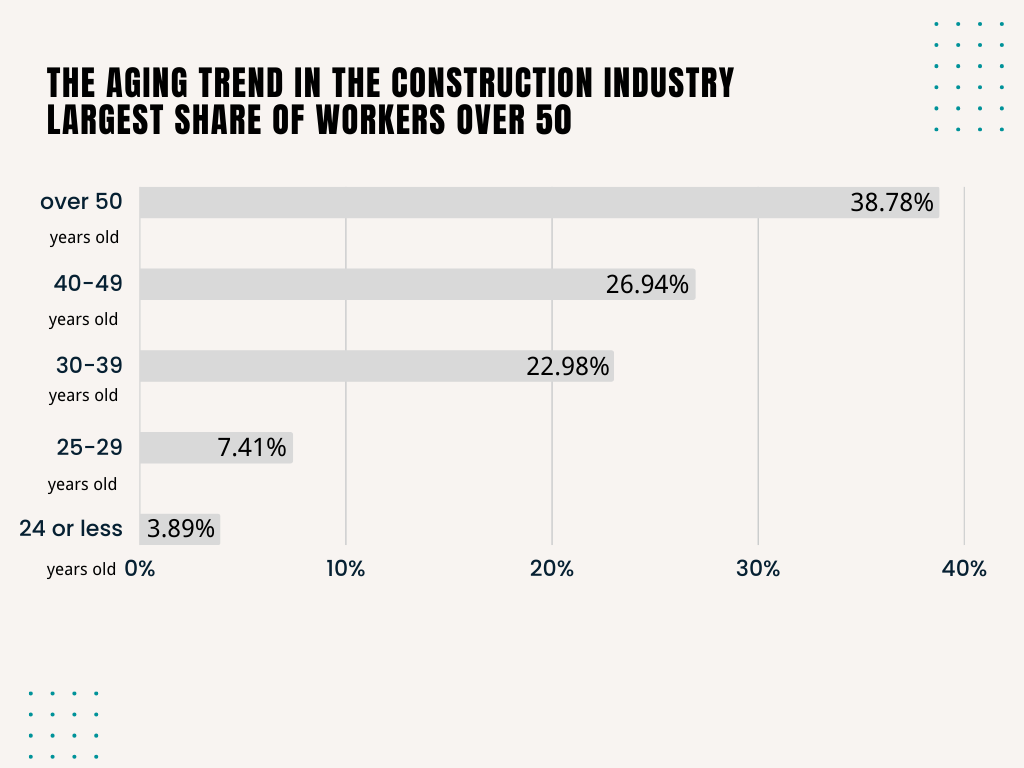
Facing the labor shortage in the construction industry and the aging workforce, construction robots have become a major trend. In this regard, focusing on diverse construction scenarios, 24 cities encourage the promotion of construction robots with different functions and application scenarios.
Construction Robots for On-site Construction
For Main Structural Works
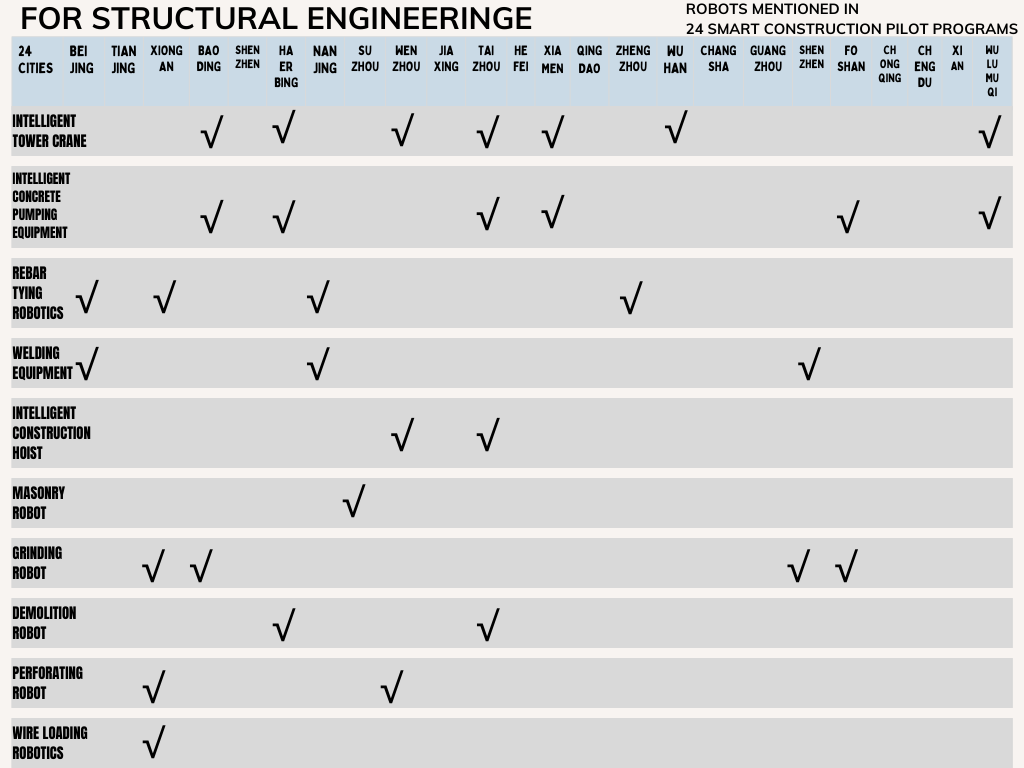
For the difficult and dangerous construction projects , the 24 cities require accelerating the use of construction robots. The Xiamen Intelligent Construction Pilot City Construction Implementation Plan requires the strengthening of the research and development of the application of construction robots in order to alleviate the current situation of "dangerous, complicated, dirty and heavy" construction. For structural engineering, it is more dangerous. For example, the fall of tower cranes can easily lead to injuries and deaths, and the difficulty of concrete pumping is high. Among the 24 implementation plans, intelligent tower cranes are mentioned most frequently as construction robots for on-site structural works.
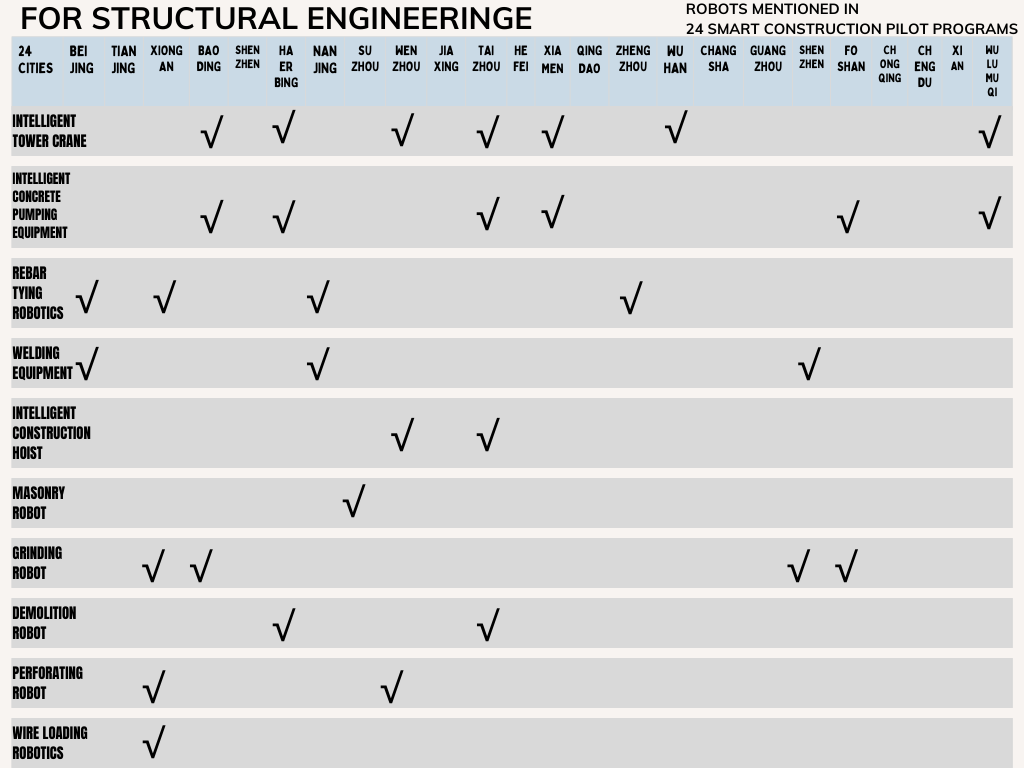
Among them, with the development of assembled construction, China's tower crane industry demand continues to increase. According to the China Construction Machinery Industry Association's data, in 2022, China's tower crane industry output is about 90,000 units, a year-on-year growth of nearly 20%. Artificial intelligence technology is also gradually applied in the tower crane industry. In the 24 intelligent construction pilot cities, Xiamen and other 7 cities encourage the application of intelligent tower crane.
In addition, for the high risk of concrete pumping and rebar tying, Beijing puts forward to expand the application of construction robotics scenarios. In order to achieve high efficiency of concrete pouring and rebar tying, Beijing promotes the innovative application of construction robots in the production of concrete precast components and other construction links.
Among them, rebar tying operation requires workers to bend down for a long time, which is physically burdensome and may cause casualties if they are not careful. However, rebar tying robots can reduce the need for labor, and to assist workers to achieve high efficiency. Taking the semi-automatic rebar-tying robot independently developed by the HKCRC team as an example, the robot can continuously bind and tie bar joints at high speeds with the assistance of one worker.
For Decoration Works
A number of cities encourage the application of various types of construction robots, including spraying robots, in the indoor and outdoor decoration segments. Among them, spraying robots are the most emphasized, with eight cities mentioning spraying robots, followed by smoothing /leveling/plastering/plastering robots, which are mentioned by six cities.
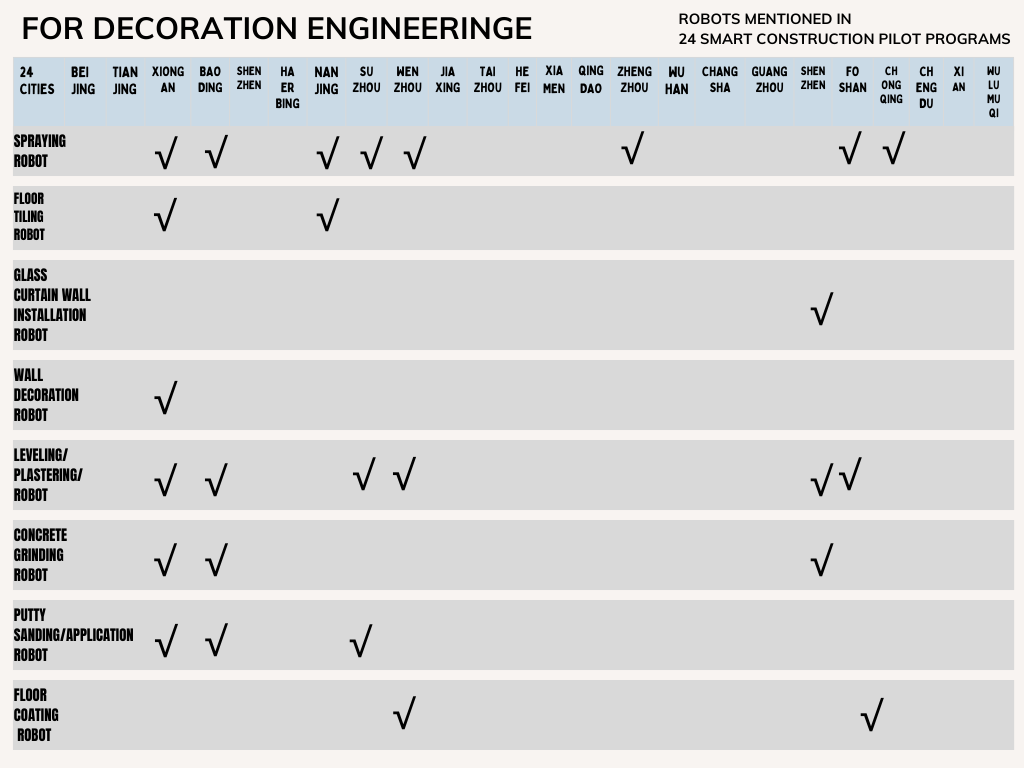
Xiongan New Area is the city with the highest number of mentions of construction robots in this application scenario. Xiongan New Area encourages the active trial use of construction robots to substitute and assist construction in multiple scenarios, such as face decoration.
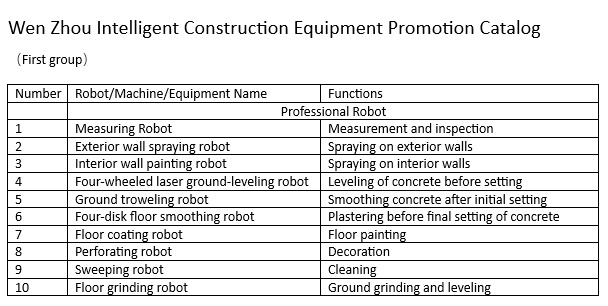
Wenzhou, one of the 24 pilot cities, includes ten professional construction robots in its intelligent construction equipment promotion catalog, including exterior/interior wall spraying robots, ground leveling robots, etc., as shown below.
Construction Robots for Prefabricated Components Application
In July 2020, the Ministry of Housing and Urban-Rural Development mentioned that there are two different types of construction robots, construction-site-side and factory-side. The robots mentioned above are those that are directly or indirectly involved in the on-site construction process.
There are also robots used in factory, involved in the application of prefabricated components, such as transportation robots for prefabricated component transportation, and wall panel installation robots. One third of the pilot cities encourage the application of transportation robots.
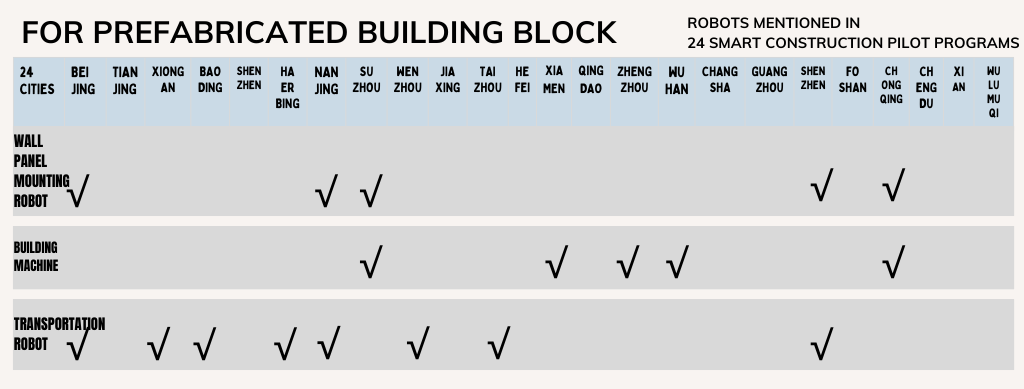
For the transportation and installation of prefabricated components, the General Logistics Robot can realize automatic unloading, zero-contact transportation and zero-loss transportation through manual operation, which greatly improves the transportation efficiency and relieves the physical burden of workers.
Construction Robots for On-site Maintenance and Construction Measurement
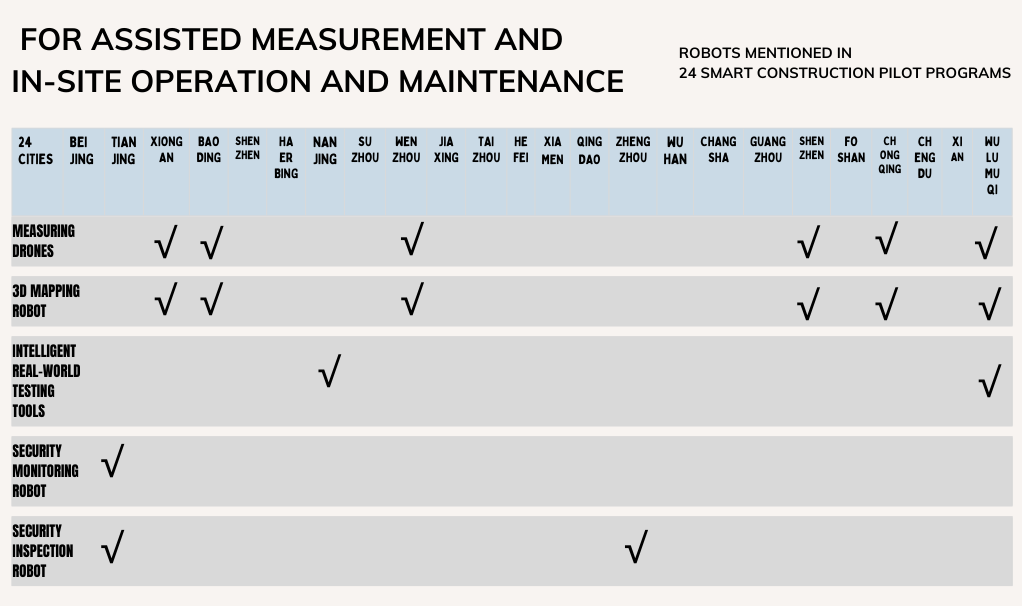
In order to ensure the accuracy of measurement data on the construction site, measurement drones and 3D mapping robots have become popular.
Urumqi encourages the promotion of measurement robots and intelligent measurement tools, such as measurement drones and three-dimensional mapping robots. Meanwhile, Xiong'an New Area, Wenzhou , Chongqing also encourage the use of robots and related intelligent equipment in surveying and mapping.
Taking the intelligent inclinometer as an example, the traditional ruler requires a person to identify the error based on the level bubble, and needs to be recorded manually. The intelligent ruler, through the Internet of Things (IoT) technology and sensor technology, does not require manual reading to obtain data, and the measurement data can be instantly transmitted to the cloud (BIM) wirelessly.
In addition, in the field of operation and maintenance, inspection, the Beijing emphasizes the innovative application of building safety monitoring, security inspection and other aspects, to expand the application of construction robots to the operation and maintenance inspection.
Relying on Professional Organizations to Promote the Development of Construction Robots
For these 24 cities, to realize the application of construction robots, technological empowerment is the key. For example, Chongqing mentions in the implementation plan to strengthen the technology research and development and transformation. It relies on Chongqing Intelligent Construction Research Institute, Chongqing Modern Construction Industry Development Institute and other organizations. In March this year, 2023 China (Chongqing) International Intelligent Construction Industry Innovation Conference opened in Fuling, from Chongqing Intelligent Construction Research Institute, Hong Kong Center for Construction Robotics (HKCRC) and other experts gathered at the conference, a number of intelligent construction products debut.
Finally, the strengths of both cities and research institutes need to be combined to develop construction robots. It can cope with complex scenarios, forming a synergy to promote the development of intelligent construction.



Get In Touch
Have questions or want to explore collaboration? Reach out to our team and let’s build the future of construction together.