HKCRC Products Shine at 2026 Occupational Safety & Health Innovation Expo:Exploring a New Era of Smart Construction
Jun 04

The Occupational Safety and Health (OSH) Innovation Expo, co-organised by the Hong Kong Labour Department (LD) and the Occupational Safety and Health Council (OSHC), concluded on June 3. Over the course of two days, the expo brought together more than 100 organisations from Hong Kong, the Greater Bay Area, and beyond, showcasing innovative solutions, products, and technologies aimed at advancing occupational safety and health through applied technological innovation.
At this year's expo, the HKCRC presented a suite of cutting-edge products, including the AI Tower Crane System, Rebar Tying Robot, Water Tank Cleaning Robot, and AI 3D Measurement Scanner. Visitors to the booth were drawn to these silent "guardians" already operating on construction sites, underwater, and at dizzying heights.
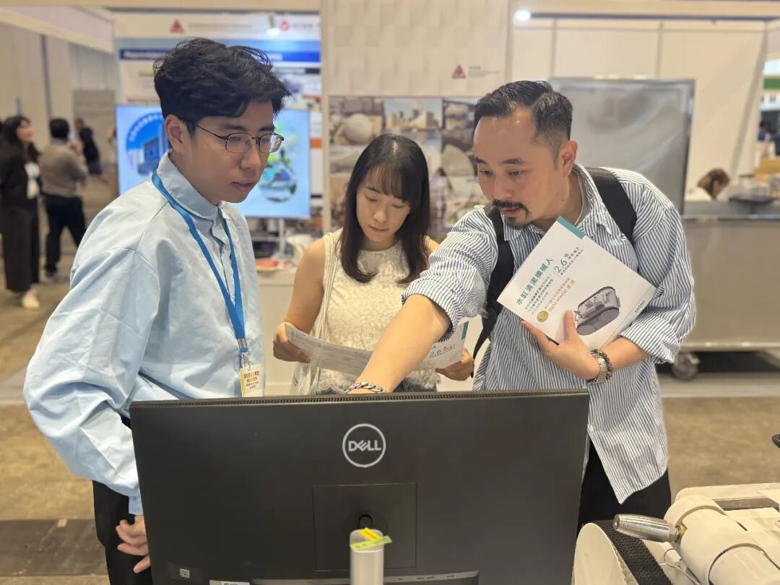
Water Tank Cleaning Robot Team: Sending Robots Where It's Most Dangerous to Go
Among the showcased innovations, the Water Tank Cleaning Robot stood out as one of the most compelling. As Jerry, a mechanical engineer at HKCRC, explained, the robot’s core technology lies in its sealed-compartment waterproofing system, enabling fully autonomous cleaning without human intervention. "Workers no longer have to enter damp, confined, oxygen-deprived tanks to scrub sediment in the dark," he said. "This machine takes over the most back-breaking, lung-damaging, and life-threatening parts of the job." At the expo, visitors were most curious about battery life and ease of operation—a clear sign that the industry’s expectations are grounded in practicality: solutions must not only work in theory, but also withstand the rigours of real-world job sites.
CraneR Team: Giving Tower Cranes the Power to "See" Danger
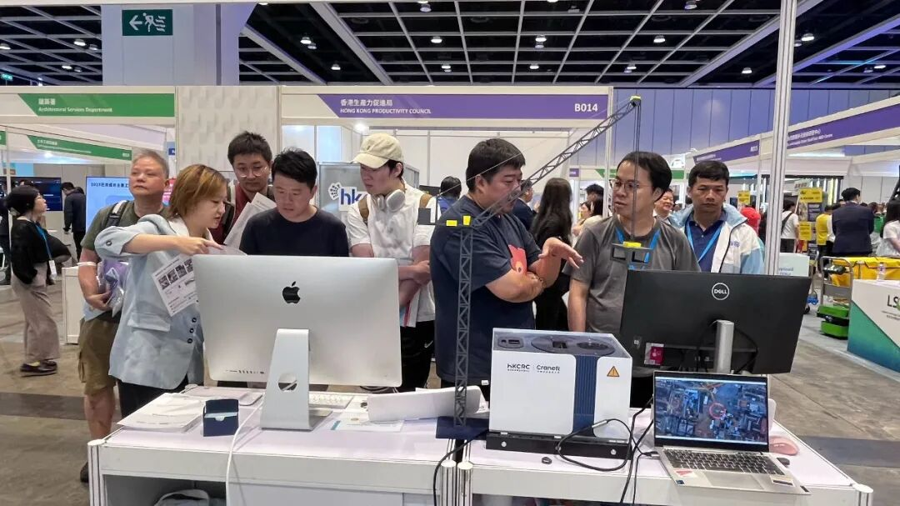
The AI Tower Crane system CraneR and AI-powered safety monitoring module CraneEye, developed by HKCRC’s spin-off team Keyuetech, likewise drew substantial attention. CraneR allows operators to step out of the high-altitude cab and control the crane from the ground, combining remote operation with AI-driven auto-path planning and anti-sway control to enhance both productivity and safety. CraneEye, meanwhile, can be retrofitted onto existing tower cranes to detect in real time the proximity of workers and equipment around the hook, triggering automatic alerts when risks arise.
Chelsea, an algorithm engineer on the team, shared the threefold challenges faced during deployment: identifying small targets in complex construction environments, adapting to diverse site conditions, and overcoming the industry's hesitancy toward new technologies. Through targeted training strategies, modular design, and on-site hands-on support, the team eventually boosted recognition accuracy to approximately 95%, gradually building trust—from operators to government agencies—with hard data.
Representatives from the Labour Department, OSHC, and the Architectural Services Department paid particular attention to CraneEye’s compliance capabilities in real-time detection, automated logging, and event traceability, recognising these as essential technological enablers for the smart construction sites of the future.
ENSIGHTFUL Team: Reimagining Inspection with 3D Intelligence
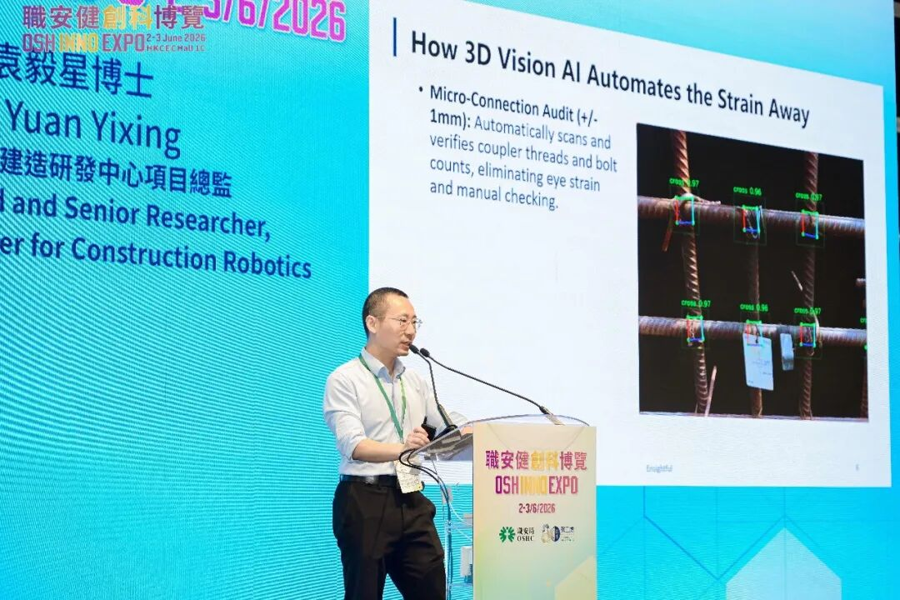
ENSIGHTFUL’s product addresses the musculoskeletal strain that frontline workers suffer from repetitive actions—bending, climbing, and kneeling—over years on site. Their solution is an intelligent inspection system driven by a 12-megapixel 3D vision core.
The system automatically extracts rebar count, spacing, and diameter, achieving micro-connection precision within ±1 mm, and instantly calculates crack or water-stain areas—reducing workers’ exposure time in high-risk zones by 75%. In trials involving MiC (Modular Integrated Construction), the AI flagged a 5-millimetre interface deviation before the modules left the factory, preventing costly on-site rework and the physical toll of forced assembly.
Curtains Down, Safety Rises
Behind every exhibit at this expo lies a specific, urgent pain point: oxygen deprivation and toxic fumes inside water tanks, the vertigo of tower-crane heights, and the endless cycles of stooping and counting that define a worker’s day on site.
The 2026 OSH Innovation Expo may have drawn to a close, but the robots diving into water tanks, the operators controlling cranes from solid ground, and the workers now completing inspections with a simple smartphone scan are already writing a safer, more humane future on construction sites across Hong Kong—and around the world.



Get In Touch
Have questions or want to explore collaboration? Reach out to our team and let’s build the future of construction together.